
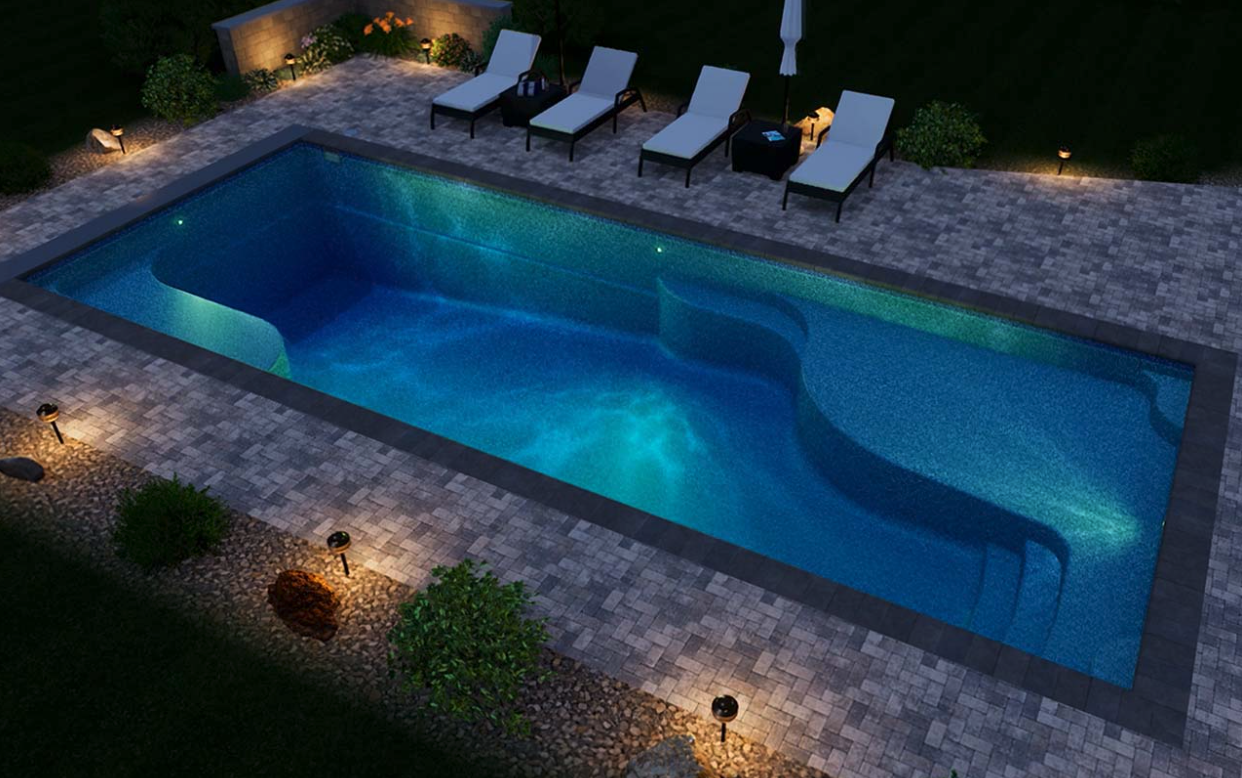
You’re thinking about putting in a pool. You’ve done some research. Maybe you’ve talked to a neighbor who has a shotcrete pool, or you grew up swimming in one, and you’ve kind of just assumed that’s how pools work. Solid, custom, built in place — that’s what a “real” pool looks like.
And fiberglass? You’re picturing something from a 1983 backyard. Faded turquoise. Egg-shaped. Kind of sad.
We get it. That image is out there. But it is so far from what modern fiberglass pools actually are that we feel obligated to intervene.
If the last fiberglass pool you saw was built before smartphones existed, you owe it to yourself to look again.
Here’s a complete, honest breakdown of what you’re actually choosing between — and why more homeowners in the Vancouver and Clark County area are choosing fiberglass when they build with Water’s Edge.
First, Let’s Set the Record Straight on Shotcrete
You’ll hear the terms “gunite” and “shotcrete” used pretty interchangeably, but they’re not the same thing. Both are forms of sprayed concrete — but gunite is a dry mix that gets water added at the nozzle, while shotcrete is a wet mix sprayed at high pressure. Shotcrete tends to be the current industry standard for pool construction, and it’s what we work with.
Shotcrete pools are built on-site, custom-formed to any shape you can dream up. They’re solid, durable, and they’ve been the dominant choice in the pool industry for decades. We respect that — and we install them.
But there are real tradeoffs that don’t always come up when you are researching, and we think you deserve the full picture.
What Shotcrete Pools Actually Require Over Time
Shotcrete is strong, but concrete is porous. Water, chemicals, and the freeze-thaw cycles we get here in Southwest Washington all work against it over time. Left unsealed, a shotcrete pool shell will absorb water, which leads to surface degradation, algae growth, and eventually structural concerns.
To combat this, quality shotcrete pool installations use a sealant. We use Hydrazzo — a professional-grade concrete sealer that significantly extends the life of the shell and helps protect against water infiltration. It makes a real difference.
But even with Hydrazzo, the maintenance picture for shotcrete includes:
- Periodic resealing. Hydrazzo and similar sealers don’t last forever. They need to be reapplied over time, especially as the pool surface experiences wear and chemical exposure.
- Resurfacing every 10–15 years. The interior plaster or aggregate finish on a shotcrete pool will eventually need to be redone. It’s a significant expense — often $10,000 to $15,000 or more depending on the finish and pool size.
- Algae management. Concrete’s porous surface gives algae something to grip. You’ll spend more on chemicals and more time brushing walls than you would with a non-porous surface.
- A rough surface. Shotcrete pools have a naturally rougher texture that can be uncomfortable to swim against, especially as the surface ages.
- Longer installation. Shotcrete is poured and finished on-site. Your backyard is a construction zone for weeks, sometimes months, while the pool cures.
None of this makes shotcrete a bad choice. It’s a proven technology, and in some situations — unusual shapes, large-scale custom designs — it’s the right call. But it’s important to go in with realistic expectations about what owning that pool will look like five and ten years down the road.
Now Let’s Talk About What Fiberglass Actually Is in 2026
Modern fiberglass pools are manufactured off-site in controlled conditions, using advanced composite technology. The pool shell arrives at your home essentially ready to go — excavate, set, connect, finish. You’re swimming in weeks, not months.We install Latham fiberglass pools, which means you’re working with one of the most recognized names in the pool industry — a company with over 70 years of manufacturing experience and an industry-leading limited lifetime warranty on their fiberglass shells.
Latham pools are engineered with multiple layers of reinforced materials — including carbon-infused technology, aramid fibers, and marine-grade resin — built for structural integrity over decades of use.
But let’s get past the specs and talk about what this actually means to live with.
The Surface You’ll Notice Every Single Time You Swim
Fiberglass pools have a non-porous, smooth gel coat surface. That single fact has a cascading effect on almost everything else about the pool:
- Algae can’t get a foothold. Without the porous texture that concrete provides, algae has nowhere to grab. You’ll use significantly fewer chemicals to keep the water balanced.
- It’s comfortable. No scraped knees on the wall. No rough surface underfoot. Guests notice.
- No resurfacing. The gel coat finish is built into the shell itself. It’s not a coating applied on top — it’s part of the structure. A properly maintained fiberglass pool can last 50 to 60+ years without the interior resurfacing a shotcrete pool requires.
- Less chemical use. Fewer chemicals means lower ongoing costs, less time managing your pool, and a gentler experience for swimmers.

“But Don’t Fiberglass Pools All Look the Same?”
This is the big one. Let’s retire this myth permanently.
The fiberglass pool of today is not the fiberglass pool of your memory. Latham offers dozens of shapes — sleek modern rectangles, flowing freeform designs, L-shapes, kidney curves, geometric pools with clean angular lines — in a range of sizes from compact plunge pools up to full-length swimming pools. There is a shape for virtually any backyard and any aesthetic.
Color That’s Built In, Not Painted On
Latham’s Crystite® gel coat comes in a range of finishes that are part of the pool itself — not a coating that can peel, chip, or fade:
- Crystite Crystal finishes: Sapphire Blue, Ocean Blue, Night Sky, Shale Gray, Coastal Bronze, Pearl White — with embedded shimmer that catches light the way water should.
- Crystite Classic finishes: The same color palette in a more understated, non-shimmer option for a cleaner, quieter look.
These aren’t your only customization options, either.
Add Tile — and Make It Completely Yours
One of the things people don’t always realize is that fiberglass pools are fully compatible with custom waterline tiling and mosaic inlays. Latham offers a curated tile collection that transforms a beautiful pool into something genuinely stunning:
- Glass tile options: The Monet Series (Paradise, Water Lilies, Sailboat, Stormy), the Night Life Series (Ballad, Galant, Melody, Soul), and the Glacier Series — all available as waterline or inlaid tiles.
- Porcelain tile options: The Abyss Series (Tikal, Port Royal, Alexandria) and the Italian Slate Series (Firenze, San Marino, Naples, Milan) for a more earthy, sophisticated look.
Think of it the way crown molding works in a room. A well-proportioned space already looks good — but that finishing detail makes it look intentional, elevated, like someone really thought it through. That’s what waterline tile does for a pool. It’s the difference between a nice pool and a pool that stops people in their tracks.
You choose the gel coat color, then pair it with the tile that fits your backyard style. It’s a genuinely personalized result.
Tanning Ledges, Spas, and Built-In Features
Another piece of the “fiberglass is basic” myth: the idea that you can’t get the features you want. You absolutely can.
Many of Latham’s pool models come with built-in tanning ledges — the shallow sunbathing platform where you can put lounge chairs in a foot or two of water. Some models include integrated spas with spillover water features. There are auto-cover-ready designs, swim-up seating, multiple entry and exit points, and more.
These aren’t add-ons bolted on later. They’re engineered into the pool structure, which means they look intentional because they are.
You’ll Be Swimming Sooner — That Matters Here
We’re in the Pacific Northwest. Our outdoor swimming season is real but finite. Every week you’re waiting for your pool to cure is a week you’re not in it.
With a fiberglass pool, installation is dramatically faster than shotcrete. The shell arrives pre-manufactured. We excavate, set it, make the connections, and get to finish work. You’re looking at weeks, not months.
For a shotcrete pool, the shell has to be built on-site: framed, sprayed, cured, and then finished with plaster or aggregate. Weather delays are real. That construction timeline can stretch, especially if you’re trying to get done before summer.
The Short Version: Side by Side
| Fiberglass (Latham) | Shotcrete | |
|---|---|---|
| Installation time | Weeks | Months |
| Interior surface | Smooth, non-porous gel coat | Plaster or aggregate (porous) |
| Resurfacing needed? | No | Yes, every 10–15 years |
| Sealing required? | No | Yes (e.g., Hydrazzo), needs reapplication |
| Algae resistance | High (non-porous surface) | Lower (porous surface) |
| Chemical use | Lower | Higher |
| Custom colors | Yes — Crystite gel coat collection | Yes — plaster color options |
| Tile & mosaic options | Yes — glass and porcelain waterline/inlaid | Yes |
| Tanning ledges / spas | Yes — engineered into shell | Yes — built custom on-site |
| Custom shapes | Dozens of models; some limitations | Fully custom |
| Warranty | Industry-leading limited lifetime | Varies by installer |
So, Which One Is Right for You?
If you have an unusual site, a highly irregular shape in mind, or specific design requirements that fall outside the range of available fiberglass models, shotcrete may be worth discussing. It’s still a solid option, and we can build it well.
But if you walked in here thinking shotcrete is your only “real” option, and fiberglass is the budget alternative? We’d respectfully push back on that. Modern fiberglass pools are beautiful, durable, customizable, and significantly easier to live with over the life of the pool. For most homeowners, they’re not the compromise — they’re the upgrade.
The pool you’re imagining? There’s a good chance it exists in fiberglass. Let’s find out.
Ready to see what’s actually possible?
Book a free consultation with Water’s Edge Pools & Spas. We’ll walk you through the Latham fiberglass lineup, show you color and tile combinations, and give you a real picture of what your project would look like — from first shovel to first swim.